
What manufacturers and exporters need to know about packaging requirements, compliance deadlines, recyclability, technical documentation and supplier management
Packaging used to be treated as a logistics detail.
For companies selling appliances, electronics, water purifiers, air purifiers and other products into Europe, that approach is becoming increasingly expensive.
Under the EU Packaging and Packaging Waste Regulation (PPWR), packaging is being treated as a regulated product in its own right. Material selection, recyclability, restricted substances, recycled content, labelling, documentation and producer responsibility are gradually being brought into one regulatory framework.
For B2B exporters, this means that compliance can no longer be checked only when a shipment is about to leave the factory.
The packaging specification itself increasingly needs to be designed with the European market in mind.
And that is where things become interesting: a cardboard box may look like a cardboard box. From a compliance perspective, however, the details can be surprisingly less simple.
The Packaging and Packaging Waste Regulation (PPWR) is Regulation (EU) 2025/40, the EU’s new legal framework for packaging and packaging waste.
It covers packaging throughout its lifecycle, including:
The regulation entered into force on 11 February 2025 and will generally apply from 12 August 2026.
Importantly, PPWR should not be viewed simply as a replacement for national EPR systems.
EPR and PPWR address different layers of compliance.
National EPR schemes remain relevant for producer registration, reporting and financing waste management, while PPWR establishes harmonised EU-level requirements for packaging itself.
For an international appliance supplier, therefore, the practical question is not simply:
“Do we have packaging EPR registration?”
It is: “Can we demonstrate that the packaging placed on the EU market complies with the applicable PPWR requirements?”
The PPWR does not switch every requirement on at exactly the same time. Different obligations are introduced progressively.
Understanding the timeline is therefore essential for procurement and product-development teams.
12 August 2026 — PPWR Starts Applying
The PPWR generally becomes applicable on this date.
From this point, the regulation’s requirements that are already applicable must be taken into account for packaging placed on the EU market.
Article 6 establishes the principle that packaging placed on the market must be recyclable. However, the detailed methodology for demonstrating recyclability through design-for-recycling criteria develops through subsequent delegated and implementing acts, with the principal detailed requirements applying from 2030.
For B2B suppliers, 2026 should therefore be treated as the compliance preparation deadline, not the year to wait for a finished box before asking whether it is compliant.
From 2030, packaging recyclability will be assessed using the PPWR’s design-for-recycling framework.
Packaging recyclability is expressed through performance grades A, B or C. The regulation establishes different thresholds for these grades, with Grade A corresponding to at least 95% recyclability assessment by weight and Grade B at least 80%.
For plastic packaging, minimum post-consumer recycled content requirements also begin to apply.
Depending on the packaging category, the 2030 requirements include:
| Plastic packaging category | Minimum recycled content from 2030 |
|---|---|
| Contact-sensitive PET packaging, excluding single-use beverage bottles | 30% |
| Contact-sensitive non-PET plastic packaging, excluding single-use beverage bottles | 10% |
| Single-use plastic beverage bottles | 30% |
| Other plastic packaging | 35% |
These percentages are not interchangeable. The applicable category needs to be identified before the requirement is calculated.
The next major step comes in 2035.
Recyclability will increasingly depend not only on whether packaging has been designed for recycling, but also on whether it can actually be recycled at scale within appropriate waste-management systems.
In practical terms, “technically recyclable” and “actually recyclable at scale” are becoming two different questions.
That distinction should already influence packaging design decisions being made today.
The recycled-content requirements increase further by 2040.
For example, the minimum requirement for plastic packaging not covered by the other specified categories rises from 35% in 2030 to 65% in 2040.
This is why packaging procurement decisions made in 2026 should not be evaluated only against today’s minimum requirements.
A packaging design that barely passes today’s requirements may become an expensive redesign project later.
One of the most important practical questions is surprisingly simple:
PPWR applies to packaging and packaging components used to contain, protect, handle, deliver or present products.
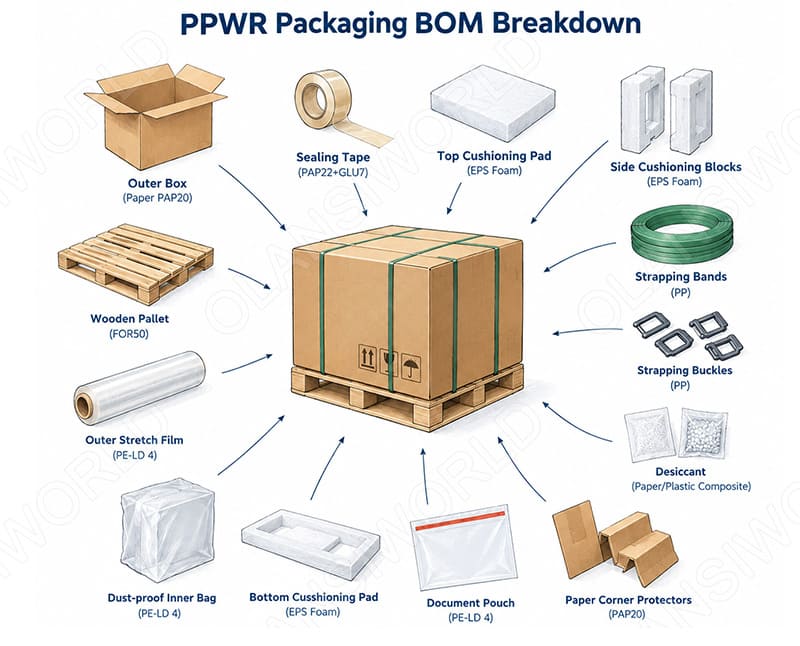
For an appliance exporter, packaging may therefore include considerably more than the outer carton.
A typical shipment might contain:
Some product-related components also need to be assessed carefully depending on their function and whether they fall within the regulatory definition of packaging.
For example, an instruction manual itself is generally not packaging simply because it is printed material. However, a plastic bag used to contain the manual can be packaging.
This distinction matters because packaging compliance should be assessed at the component level, not merely by looking at the outside carton.
A Practical Packaging Inventory
For B2B appliance suppliers, it is useful to create a packaging BOM similar to a product BOM.
For each packaging component, record:
Once this inventory exists, compliance becomes a data-management exercise rather than a guessing game.
PPWR assigns different obligations to different economic operators.
This is particularly important in OEM and private-label business because the party manufacturing the packaging and the party placing the branded product on the EU market are not necessarily the same company.
Manufacturer
Under Article 15, manufacturers are responsible for ensuring that packaging complies with applicable requirements, carrying out the relevant conformity-assessment procedure and preparing the required technical documentation and EU Declaration of Conformity.
For OEM projects, the contractual and regulatory roles should therefore be clearly defined rather than assumed.
An importer placing packaging on the EU market has its own verification and information obligations.
The importer should not simply assume that a supplier’s statement such as “EU compliant” is sufficient.
Supporting documentation should be available.
Packaging suppliers are also required to provide manufacturers with the information and documentation necessary to demonstrate compliance.
This makes supplier cooperation a practical part of PPWR compliance.
A packaging supplier who cannot provide material composition, test evidence or relevant technical information may become a compliance bottleneck.
Producer responsibility under EPR remains connected to national systems.
Therefore, PPWR compliance should not be confused with EPR registration.
A company may have completed EPR registration in a particular EU country while still needing to ensure that the packaging itself meets PPWR requirements.
For exporters, the two compliance tracks should be managed separately but coordinated internally.
If the physical package is the visible part of compliance, the technical documentation is the evidence behind it.
PPWR Annex VII requires technical documentation to provide sufficient information to demonstrate conformity.
At minimum, it should address areas such as:
The packaging and its intended use should be clearly described.
For example:
The technical file should contain appropriate design and manufacturing information, including:
The objective is not to create paperwork for the sake of paperwork.
The objective is to make the packaging technically understandable to a competent authority.
Where applicable, relevant harmonised standards or other technical specifications should be identified.
For recyclability, for example, standards and methodologies related to packaging design and material recycling may become relevant depending on the packaging format and applicable delegated or implementing acts.
The technical documentation should provide evidence supporting the packaging’s recyclability assessment.
Where recycled-content requirements apply, calculations and supporting evidence should be maintained.
Evidence concerning restricted substances should also be retained.
For example, PPWR Article 5 establishes a combined limit of 100 mg/kg for lead, cadmium, mercury and hexavalent chromium resulting from substances present in packaging or packaging components.
A common mistake is to treat PPWR testing as a final-stage inspection.
For B2B product development, that is usually too late.
Testing should be incorporated into the packaging-development process.
The combined concentration of:
must not exceed the applicable PPWR limit of 100 mg/kg.
Testing should be performed on representative packaging components and materials based on the actual packaging configuration.
PFAS restrictions should receive particular attention when packaging is intended to come into contact with food.
From 12 August 2026, food-contact packaging cannot be placed on the EU market where PFAS concentrations reach or exceed the specified thresholds, including:
The precise scope and analytical interpretation should be checked against the regulation and applicable guidance.
For ordinary appliance shipping cartons that are not food-contact packaging, this specific PFAS provision should not simply be presented as a universal packaging limit.
That distinction is important.
A RoHS report may provide useful material information, but it should not automatically be treated as a complete PPWR compliance assessment.
Different regulations have different scopes, definitions and test requirements.
A certificate with a familiar logo may look reassuring on a PDF. Unfortunately, regulations are not particularly impressed by attractive PDFs.
Recyclability is one of the most important long-term elements of PPWR.
The question is no longer simply:
“Can this material technically be recycled?”
It increasingly becomes:
“Has this packaging been designed so that it can enter the appropriate recycling stream and produce usable secondary raw material?”
PPWR’s approach considers design for recycling, collection, sorting and recycling at scale.
This creates several practical considerations for packaging development.
Packaging composed of multiple incompatible materials can create sorting and recycling difficulties.
Where technically possible, simpler structures should be considered.
Certain dark or heavily pigmented plastic components may create sorting challenges depending on the material and sorting technology used.
For packaging intended for European markets, material and colour selection should therefore be evaluated together rather than independently.
For plastic components, density and material composition can affect separation processes.
This is particularly relevant where fillers or mixed materials are used.
The precise recyclability assessment should be based on the applicable methodology rather than a single informal density rule.
A packaging component can be made from a recyclable base material and still create problems if labels, adhesives, coatings or other components interfere with sorting or recycling.
Therefore, packaging should be evaluated as a system, not as a collection of isolated materials.
Labelling is one area where online summaries of PPWR frequently become confusing.
Article 12 establishes a harmonised packaging label containing material-composition information to facilitate consumer sorting.
The general application date is 12 August 2028, or another later date where the regulation’s implementing acts make that applicable.
This means that it would be misleading to state broadly that:
“All packaging must carry the harmonised material label from 12 August 2026.”
The safer formulation for a B2B article is:
PPWR applies from 12 August 2026, while the harmonised packaging-labelling requirement under Article 12 generally applies from 12 August 2028.
This distinction is small on a timeline and rather large in a compliance audit.
No.
This is one of the most important questions for exporters.
Extended Producer Responsibility generally concerns the producer’s responsibility for the management and financing of packaging waste through applicable national systems.
PPWR establishes EU-level requirements covering the packaging itself, including:
Therefore:
EPR registration does not automatically mean that the packaging is fully compliant with PPWR.
Conversely, PPWR does not eliminate the need to understand national EPR obligations.
For companies selling across several EU markets, both systems should be included in the compliance matrix.
PPWR is an EU regulation and is designed to create a more harmonised framework across the EU.
However, this does not mean that every national packaging obligation disappears overnight.
Existing national EPR systems, producer-registration mechanisms, reporting requirements and waste-management organisations continue to matter where applicable.
For exporters, the practical approach should therefore be:
EU-level PPWR compliance + country-level EPR compliance
rather than choosing one and ignoring the other.
The United Kingdom should also be treated separately.
The UK is not covered by the EU PPWR. Companies selling packaging into the UK need to assess the applicable UK packaging regulations separately.
For an appliance manufacturer, distributor or private-label supplier, PPWR compliance can be organised into six steps.
List every packaging component used for each SKU.
Do not stop at the outer carton.
Include:
Record the exact material and composition of each component.
Avoid descriptions such as: “Plastic”
when the actual specification is available.
Record the polymer type, grade and relevant additives where necessary.
Collect supplier declarations and relevant laboratory reports.
Pay particular attention to:
Assess the packaging structure against the applicable PPWR recyclability requirements.
Where packaging is redesigned, the final production configuration should be assessed rather than an early prototype.
Create a technical file for each relevant packaging type or packaging configuration.
The file should be controlled by revision.
If the material, supplier, structure or design changes, the documentation should be reviewed rather than quietly left in a folder marked “final_final_v3”.
A useful internal matrix can include:
| Item | Material | Weight | Supplier | Test Report | Recycled Content | Recyclability | Label | Document Status |
|---|---|---|---|---|---|---|---|---|
| Carton | Corrugated board | — | Supplier A | Available | — | To assess | To assess | In progress |
| Protective bag | Plastic | — | Supplier B | Available | — | To assess | To assess | Complete |
| Foam insert | Plastic foam | — | Supplier C | Required | — | To assess | To assess | Pending |
| Product label | Paper/plastic | — | Supplier D | Required | — | To assess | To assess | Pending |
The exact fields should be adapted to the company’s packaging portfolio.
PPWR will increasingly make supplier documentation part of procurement quality.
Before approving a packaging supplier for an EU-bound product, buyers should consider asking:
1. What is the exact material composition?
2. Can the supplier provide evidence for restricted-substance requirements?
3. Is recycled content used, and how is it calculated?
4. Can the supplier provide supporting evidence for recycled content claims?
5. Has the final packaging structure been evaluated for recyclability?
6. Are adhesives, coatings, inks and labels included in the assessment?
7. Can the supplier provide technical drawings and material specifications?
8. How will compliance be maintained if the supplier changes raw materials?
The last question is particularly important.
A packaging report from 2026 is not necessarily evidence for a packaging specification that was changed in 2027.
Change control is therefore becoming part of packaging compliance.
This question deserves special attention for international appliance businesses.
In an OEM project, the brand owner, importer and supplier may all have different responsibilities.
The contract should therefore clarify:
PPWR assigns specific obligations to economic operators, while packaging suppliers must provide the information and documentation needed by manufacturers to demonstrate compliance.
For this reason, regulatory responsibility should be defined contractually rather than inferred from the word “OEM.”
The biggest mistake would be to treat PPWR as something that starts on 12 August 2026 and therefore needs attention on 11 August 2026.
That would be a remarkably efficient way to turn packaging development into an emergency project.
A better approach is to work backwards from the regulatory milestones.
Phase 1 — Packaging Audit
Identify every packaging format used for EU-bound products.
Phase 2 — Material Mapping
Document the material, weight, supplier and structure of each component.
Phase 3 — Compliance Testing
Identify missing evidence for restricted substances and other applicable requirements.
Phase 4 — Recyclability Assessment
Review packaging design before large-scale production.
Phase 5 — Technical Documentation
Build and control the required technical files.
Phase 6 — Procurement Control
Add PPWR-related requirements to packaging supplier qualification and purchase specifications.
Phase 7 — Continuous Monitoring
Track regulatory updates, delegated acts, implementing acts and future recyclability methodologies.
Before placing an EU-bound product on the market, ask:
Packaging
Restricted Substances
Recyclability
Documentation
Commercial Compliance
The most important lesson from PPWR is that packaging compliance should not be treated as a certificate collected at the end of the supply chain.
It is becoming a design, procurement, documentation and supply-chain management issue.
For B2B manufacturers and exporters, the practical priorities are clear:
Map the packaging.
Verify the materials.
Test the relevant risks.
Evaluate recyclability.
Build the technical documentation.
Clarify economic-operator responsibilities.
Keep EPR obligations under control.
And design today’s packaging with tomorrow’s requirements in mind.
PPWR is being introduced progressively, with major requirements extending from 2026 through 2030, 2035 and 2040.
For companies supplying appliances and other packaged products to European markets, early preparation can turn PPWR from a last-minute compliance headache into a manageable part of normal product development and procurement.
The box is no longer “just the box.” It is part of the product’s compliance file.
Certifications
OLANSI Repsects Quality Standards


Something isn’t Clear?
Feel free to contact me, and I will be more than happy to answer all of your questions.

Enter you email below, so we can send you this valuable report.